


Don‘t Underestimate That Black Magnet: It‘s Quietly Changing the Game for High-Speed Motors
When it comes to high-speed motors, especially those precision motors used in drones, high-end tools, or electric vehicles, the first term that likely comes to mind is "neodymium magnets" — those powerful rare-earth magnets. They‘re almost synonymous with "high performance," right? We‘ve grown accustomed to this notion: to achieve ample power and high rotational speeds, you need these top-tier materials.
But today, I want to share something intriguing and somewhat counterintuitive that‘s happening. A group of engineers are using a seemingly very "ordinary" material — ferrite magnets — to build motors that can equally reach ultra-high speeds. Yes, exactly the kind that appear blackish-gray, somewhat brittle, and very affordable.
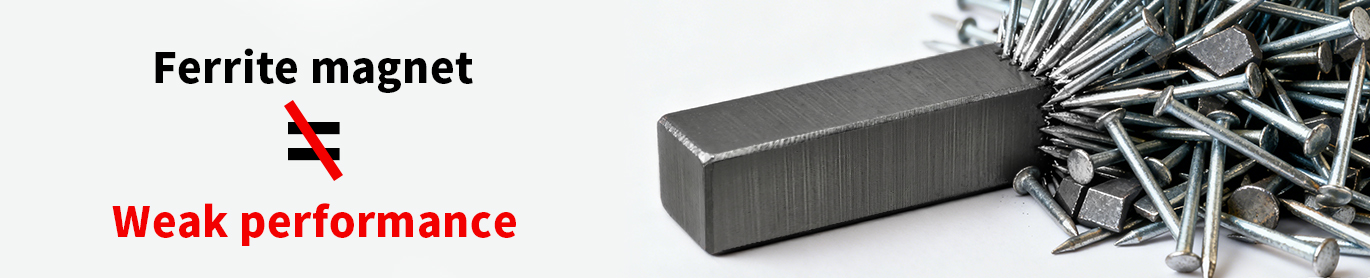
You might wonder, "Wait, aren‘t ferrite magnets much weaker in magnetic strength? How is this even possible?"
This touches on a common misunderstanding we often have. We tend to think that "stronger magnetic force" directly equals "better performance." But this is like judging an athlete not just by their instantaneous explosive power in weightlifting, but also by their endurance, heat tolerance, and overall coordination. Ferrite magnets, especially after being upgraded with modern technology, excel remarkably in these "hidden" skills.
First, let‘s talk about "high speed." What is the biggest fear when a motor spins extremely fast? Heat. A tremendous amount of heat is generated internally, and this heat is the nemesis of powerful neodymium magnets — if the temperature gets too high, neodymium magnets can irreversibly lose a portion of their magnetism, a phenomenon called "demagnetization." But what about ferrite? It‘s naturally a "heat-resistant player," remaining as stable as a rock even at high temperatures. This inherent stability is a dream-come-true feature for motors that need to run at high speeds and under heavy loads for extended periods.
Next, there‘s a cool but rarely mentioned physical property. Ferrite is an electrical insulator, whereas neodymium magnets are conductors. When a motor operates at extremely high speeds, the magnetic field changes rapidly, inducing what‘s known as "eddy current losses" within conductors. This purely wastes energy and generates additional heat. Because ferrite does not conduct electricity, it almost perfectly avoids this issue. This means that in the realm of high speeds, ferrite motors can, conversely, convert more electrical energy efficiently into kinetic energy, rather than heat.
Of course, this isn‘t to say that simply replacing neodymium magnets with ferrite ones will lead to success. The real magic lies in innovative design. Engineers are now employing smarter magnetic circuit designs, such as arranging ferrite magnets in structures like a "spoke" configuration, to more effectively focus and utilize the magnetic force. While accepting the fact that ferrite magnets have slightly lower magnetic strength, they optimize the entire system to play to its strengths and avoid its weaknesses, ultimately creating a motor that achieves a perfect balance between cost, stability, and rotational speed.
So, you see, this isn‘t just a story about "saving money" (although the cost advantage and supply chain stability of ferrite are indeed significant benefits). It‘s more a story about breaking conventional thinking.
The next time you hear about a high-performance device using a ferrite motor, don‘t think of it as "inferior." It might just represent a smarter, more robust engineering philosophy. In this era, sometimes the most elegant solution doesn‘t come from the strongest material, but from the masterful hands that understand the material‘s properties best. And ferrite, once a "supporting actor," is now stepping into the spotlight on the stage of high-speed motors, having its moment in the limelight.


 Email
Email WhatsApp